Example: Renca’s La Fabrica
| City role | La Fábrica was created as a public-purpose, non-profit agency that operates alongside the municipality as a bridge between local priorities and external partners. Chaired by Renca’s mayor, it uses political convening power to unlock business, academic, philanthropic and international collaboration. |
| Funding and revenue | The municipality provides core operating funding for La Fábrica’s team and basic costs, while project delivery is largely financed through private-sector, philanthropic, international and academic partnerships. The model has helped mobilise more than US$26 million in investment, with further investment of around US$11 million expected. |
| Operating model | La Fábrica is not a fixed membership alliance. It works through a flexible portfolio of partnerships, matching Renca’s problems, opportunities and gaps with the capabilities, resources and motivations of companies, universities, NGOs, foundations and international organisations. |
| Scale and governance | La Fábrica has a team of around 10-11 staff and has built more than 200 partnerships across local, national and international ecosystems, resulting in more tha 550 projects. Governance varies by opportunity, from single-project arrangements to multi-year partnerships with defined portfolios, budgets, meetings and reporting. |
| Key partners | Municipal departments, local businesses and major companies, SMEs, universities, NGOs, foundations, international organisations, philanthropic funders, national government actors and community groups. |
Introduction and context
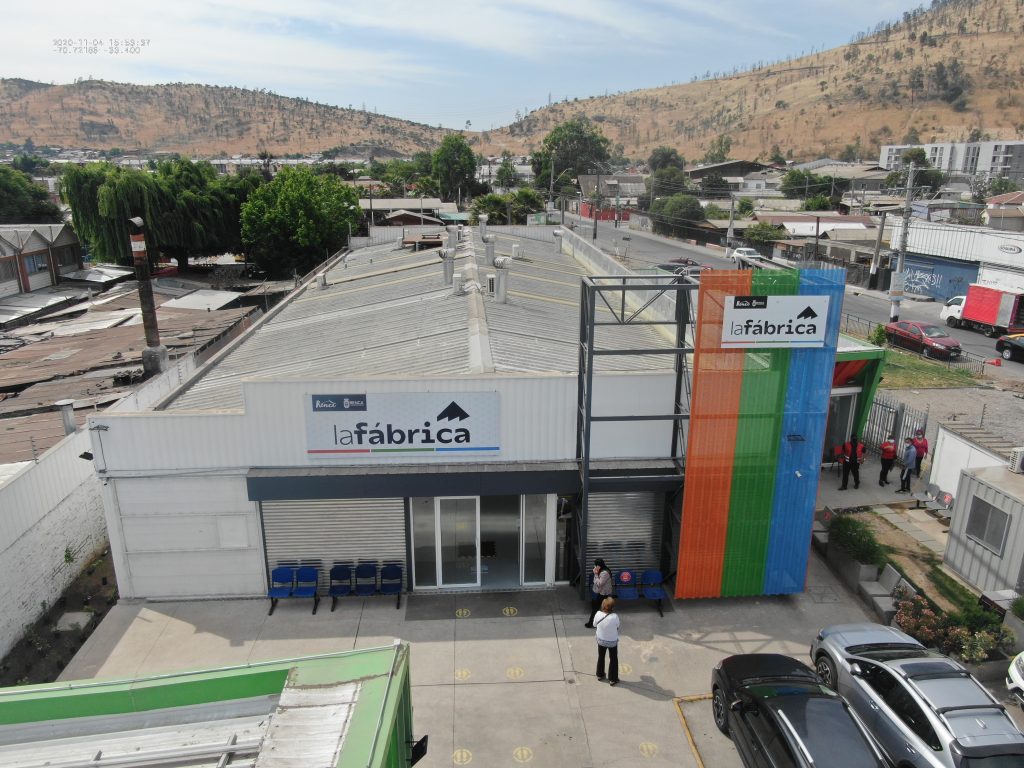
Renca is a municipality in Chile’s Santiago Metropolitan Region, where climate action intersects with inequality, economic opportunity, urban transformation and access to green space. La Fábrica was formally created in 2020 by transforming an abandoned supermarket into a public innovation institution: a physical and organisational platform that connects Renca’s needs with external capabilities and resources.
La Fábrica is a legally separate, non-profit, public-purpose institution, chaired by the mayor but able to operate with greater flexibility than the municipality. Its small team brokers partnerships across the private sector, academia, philanthropy, NGOs and international organisations, while municipal departments remain central to delivery. Climate action therefore sits within a wider innovation and partnership model, rather than a standalone business engagement programme.
How the partnership works
La Fábrica translates local problems, opportunities and gaps into investable or deliverable projects, then matches them with partners whose capabilities, ESG priorities, resources or technical expertise can respond. It also brings ideas, technologies, finance, networks and project opportunities back into Renca, aiming to create visible local benefits.
A broker between municipal priorities and external ecosystems
The team does not usually implement projects directly. Instead, it identifies opportunities, structures partnerships, secures resources and supports coordination, while relevant municipal teams deliver many projects on the ground. This gives the municipality access to expertise and finance beyond public budgets, and gives partners a clearer route through municipal systems and local priorities.
Flexible partnership models shaped around each opportunity
Governance is adapted to each partner and project. Collaborations may involve a single initiative, joint teams, signed agreements, weekly progress meetings or multi-year plans with defined projects and budgets. With a small number of major companies, La Fábrica has secured three-year, multi-project partnerships worth around US$1 million each, reflecting trust built through earlier collaboration and results.
Matching business motivations with community benefit
La Fábrica invests in understanding both Renca’s priorities and businesses’ motivations, identifying where commercial or sustainability goals overlap with local needs. Smaller shared wins help build confidence, including connecting SMEs and local entrepreneurs into larger company value chains, supporting business improvement districts, and framing climate and sustainability projects as part of broader economic and urban transformation.
Climate delivery through flagship projects
Climate action is embedded in Renca’s climate strategy and delivered through a portfolio of projects. The flagship is the Cerros de Renca Metropolitan Park (PMCR): the ecological rehabilitation of a degraded hillside of around 207 hectares, with more than 85,000 trees planted and over 40,000 residents, students and organisations engaged. Around US$7.6 million was invested between 2018 and 2025 in a public–private split close to 60/40, and a CAF-supported valuation estimates the park’s ecosystem services at about US$8.9 million a year by 2035, with health as the largest share. The Cerros de Renca Metropolitan Park Aqueduct, developed with municipal teams, academia, Coca-Cola Andina and other companies, aims to irrigate the park with treated industrial wastewater, linking circular water management, green space, social benefit and private investment.
Other examples include rooftop solar at a private industrial site through a city-to-city collaboration with Toyama, a smart water centre monitoring public-facility water use, and youth climate action funding for community-led projects.